Showing posts with label Life. Culture. Show all posts
7.04.2011
Bad habits
Can you name your bad habits? Ok... you don't drink, you don't take drugs, you exercise, you don't smoke, you don't curse, you don't eat your fingernails, you don't touch your hair all day long, you don't stop taking showers for 5 days in a row... Are you really so perfect and free of bad habits?
What if your bad habits are related to food, and so hidden by society you don't even notice them?
Bad habits is a Mexican movie released in 2007. It talks about bad habits, but not such as taking drugs, or biting your fingernails. It's more about food.
I realised food in Mexico is a big deal when I was leaving outside. There's a whole food culture here in Mexico, and I'm so happy about it. The problem is that we also give further meanings to food, food consumption, pleasure... well, I think you know where am I going.
Another big issue in Mexican culture is religion, being Catholic religion the most popular one here in Mexico, with lots of big churches, saints, statues, and a whole culture built around it, mixed with cultures of our past to create what Mexico is today.
This movie mixes both, in a strange way. Ok, all the problems are in one family, so all the "bad habits" can be shown and related in some way, let's say it's just an excuse to relate stories, so I don't think it's THAT bad. The interesting thing is that we are not seeing the classical teenager throwing all she had for lunch to be accepted at school, or the big chubby guy with problems who is bullied all the time. Here, the characters are everyday people in Mexico city and the way they see food... well... it represents lots of things.
Here you can see the story of a mother who is obssesed with her weight, an anorexic, in fact, not eating and exercising a lot. You will find the story of her daughter, who is a little girls and a bit chubby and how she hates that, and the eating disorder she is provoking to the little girl. You will find the story of her husband, an architect of a prestigiuos and religious university who ironically loves food and cheats on his wife with someone who also loves food. He is looking for an explanation for the flood of the school he's working. Guess what? realted to food as well. You will also find the story of a nun who's extremely narcisist and has serious food issues that lead her to crazy things and hallucinations.
Food can be seen as a pleasure, a need, a sin, a prize, a monster chasing you, love, nourishment, the most threatening stuff, a punishment, a sex toy, a temptation... well.. everything food is and represents to different people.
Talking about light, I find it really interesting how light and sound are related. Most of the movie is darked and in whispers. It's on the rainy season, so darkness is not a real problem, I think it enhances the feeling of the places, speacially the church and monastery. I have always found those places really creepy and I don't like going inside them as I get goosebumps. In lots of movies, this is not shown, but in this one... well, places are creepy, university is working in daylight and looks so common, the house looks so unpersonal... I think they didn't make a huge effort with the lighting, but they didn't really fake it, so I guess the atmosphere was captured, and it was fantastic how they could match it with the sound levels.
Hope you like it.
Lots of love!
Orquidea
5.08.2011
May 3rd
Last May 3rd was hold a big celebration in every cosntruction site here in Mexico. It's the "Day of the Saint Cross" or "Día de la Santa Cruz". I didn't heard about this day until I began studying architecture, but it seems it's a big deal.
This day, in every construction site, people stop working at midday and the party begins. Traditional mexican food, lots of food, music, people working in the office with no direct contact to the site also go, as well as their partners, and there's a huge party going on. What else is needed but food, drink, music, and people? (All of this obviously paid by the company or architect or ingeneer in charge)
A big cross made with things from the construction site, "beautified" with paper and flowers and blessed by a priest is put in the highest point. And the party begins.
My sister's got to do a homework on some tradition about a culture she chose and she chosed this example, so I helped her looking for the origins of this celebration and I got so surprised. I'll tell you something about this.
In the III century, empress Elena, wife of Constantito Cloro, was obsessed with finding Jesus's cross. She asked his husband for the authorization of demolishing a Roman Empire god's temple on the top of "Mount Calvario", as she was sure to find it in there. When she got the authorization, and lots of workers, she destroyed the temple and found 3 crosses, one of Jesus, two of the thieves at his sides. To identify Jesus's cross, she layed a man that was dying over the three of them and Jesus's could make him well again. As the cross was found by construction workers, it is belived to be more "theirs", or they feel it as if it belonged to them.
In Mexico, on May 3rd, it was traditionally a party during a colony of certain groups of people. Right now, the most important group are the construction workers. It is even known as "Día del Albañil" (Construction worker day).
Long ago, in Mexico, Catholic Spanish were used to making a cross at the top of the houses or temples and beautify it with flowers on May 3 (Celebration by the Catholic church as the day of the Saint Cross).
Priests took this tradition to Mexico, and during the construction of their temples, they asked the construction workers to make a cross and put it at the top of the construction. This way, they began with this tradition, making it theirs.
In 1960, the Pope John XXII supressed this celebration from the calendar, nevertheless, the celebrations here in Mexico continued, so Mexican Church asked him to keep it in Mexico, even though it was supressed in the rest of the world. He said yes, so the celebration here in Mexico, officially continued, and every May 3rd, the construction workers celebrate their day. :)
I find it really interesting a beautiful to have so many parties, and such strong believes here in Mexico. I hope they never end. I, myself has just been once in a small celebration, not as huge as the ones I desribe and have heard about, but it was nice. Food, people, in the middle of the site, even pics of the complete team (which I don't have by the way...) I hope to be in another one some other day.
Here are the references I used for the info given. For any doubts, check the out (both in Spanish, though).
http://www.culturafronteriza.com/diasanta_cruz.htm
http://radiocentro1030.mx/grc/redam.nsf/vwALL/XPAO-7ECJAR
Lots of hugs and kisses!!!!
This day, in every construction site, people stop working at midday and the party begins. Traditional mexican food, lots of food, music, people working in the office with no direct contact to the site also go, as well as their partners, and there's a huge party going on. What else is needed but food, drink, music, and people? (All of this obviously paid by the company or architect or ingeneer in charge)
A big cross made with things from the construction site, "beautified" with paper and flowers and blessed by a priest is put in the highest point. And the party begins.
My sister's got to do a homework on some tradition about a culture she chose and she chosed this example, so I helped her looking for the origins of this celebration and I got so surprised. I'll tell you something about this.
In the III century, empress Elena, wife of Constantito Cloro, was obsessed with finding Jesus's cross. She asked his husband for the authorization of demolishing a Roman Empire god's temple on the top of "Mount Calvario", as she was sure to find it in there. When she got the authorization, and lots of workers, she destroyed the temple and found 3 crosses, one of Jesus, two of the thieves at his sides. To identify Jesus's cross, she layed a man that was dying over the three of them and Jesus's could make him well again. As the cross was found by construction workers, it is belived to be more "theirs", or they feel it as if it belonged to them.
In Mexico, on May 3rd, it was traditionally a party during a colony of certain groups of people. Right now, the most important group are the construction workers. It is even known as "Día del Albañil" (Construction worker day).
Long ago, in Mexico, Catholic Spanish were used to making a cross at the top of the houses or temples and beautify it with flowers on May 3 (Celebration by the Catholic church as the day of the Saint Cross).
Priests took this tradition to Mexico, and during the construction of their temples, they asked the construction workers to make a cross and put it at the top of the construction. This way, they began with this tradition, making it theirs.
In 1960, the Pope John XXII supressed this celebration from the calendar, nevertheless, the celebrations here in Mexico continued, so Mexican Church asked him to keep it in Mexico, even though it was supressed in the rest of the world. He said yes, so the celebration here in Mexico, officially continued, and every May 3rd, the construction workers celebrate their day. :)
I find it really interesting a beautiful to have so many parties, and such strong believes here in Mexico. I hope they never end. I, myself has just been once in a small celebration, not as huge as the ones I desribe and have heard about, but it was nice. Food, people, in the middle of the site, even pics of the complete team (which I don't have by the way...) I hope to be in another one some other day.
Here are the references I used for the info given. For any doubts, check the out (both in Spanish, though).
http://www.culturafronteriza.com/diasanta_cruz.htm
http://radiocentro1030.mx/grc/redam.nsf/vwALL/XPAO-7ECJAR
Lots of hugs and kisses!!!!
3.29.2011
Light me a light
Lately I have been doing something I shouldn't be doing, cause it makes me sad and confused: I've been watching news.
I look all around me, and listen to stories about my country, I receive mails telling me how to protect against being kidnapped or robbed, I turn on the TV and see news such as revolutions and protests and disasters all around the world.
A year ago, when a friend was leaving, I gave her a candle light, small and yellow. I also gave her a chocolate I took from Mexico, and a small letter. The letter was to tell her I missed her. The chocolate to sweaten her life, and the candle light to light her way, to brighten her future. A nice metaphore for wishing her all the best now that we would come appart and who knows when would we be meeting again.
A candle, a light. So many things to be said with a single light surviving and giding us on the darkest nights, in the darkest moments, just a single and tiny light to have hope and trust in the future.
I want to see that light. I'm tired of so many sadness in the world. What is happening? I wish there could be a light, a light we could all see that anounces us a better world, a better future, the so desired happy ending. I guess it would be nice if we could all, just turn on a light.
I leave you a poem I love from Barak Al'Mondia: Light
Light me a light any kind of light,
Just shine its beam into my darkest night,
For like a child I stay up in fright,
So light me a light any light tonight.
Candlelight, moonlight any light is just right,
For in that light I might find my might!
Don’t sing me a song, don’t hold me tight,
Just light me a light, any light tonight.
Light me a light to assist my sight,
Just my naked eye darkness cannot fight,
So before darkness gets a chance to bite,
Light me a light any kind of light.
Flickering, glaring or outright bright,
I don’t care what kind just light me a light,
All I need is darkness away tonight,
So light me a light any kind of light.
so... please, light me a light, any kind of light. Light the world a light... any kind of light.
hugs and kisses,
Orquidea
2.26.2011
Library "Sebastián Lerdo de Tejada"
Yesterday I went downtown with my dad, and it was such a sunny and beautiful day and I had such a good time. I rarely go downtown, and it's not because I live in the suburbs, but because it is usually full of people and noise and... too much life... and if I have no reason for going, then I don't.
Oh, I live in Mexico city, one of the biggest cities in the world, full of life and chaos everywhere, so there's no need to travel a lot to find it, and you find yourself or accepting it, or trying to avoid it. We usually call this caothic but amazingly beautiful zone full of people and places,and history, and surprises around every corner, and mavelous buildings and stories... "el centro".
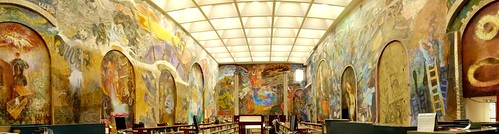
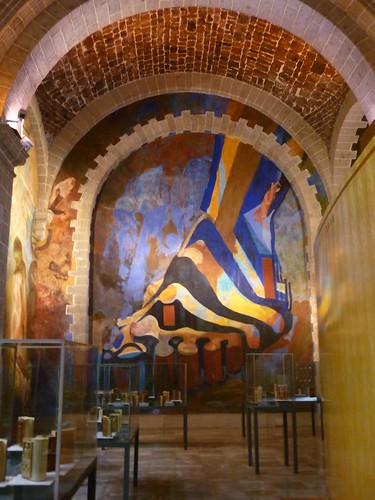
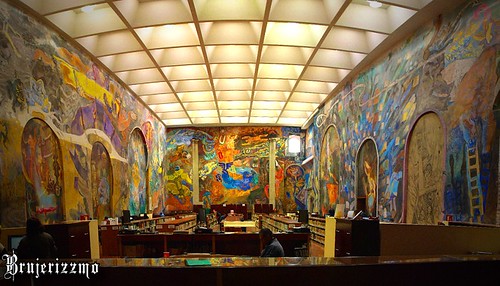
So Yesterday I went to "el centro" with my dad and walked for almost 5 hours without rest, and I found a building I liked, as it was a bit different from the rest having a small square in front of it, and being really old. I thought it was a church as it looked like one, but no, it wasn't. My dad told me it was a library, very beautiful in the inside, so I told him: "oh, please, let's go inside! Just for a little while!" So we went inside and I was astonished: an explosion of colors in the walls, really well lit from above, (daylight and artificial light, amazing!) and so well cared, and the floors were so pretty!
Adress: República de El Salvador 49,
Centro Histórico. C.P. 06080
Delegación Cuauhtémoc
Tel: 3688 98 37 y 3688 98 33
Contact: biblioteca_lerdo@hacienda.gob.mx
Link: http://www.hacienda.gob.mx/cultura/museo_virtual_biblioteca_lerdo/index.htm
Next time, I'll definitely take my camera for some pics of mine (this pics were from flickr) and I will absolutely stay much more time than this.
Hugs and kisses and a lovely weekend!!!!
12.11.2010
Las mujeres exigimos respeto! Women demand respect!
LAS MUJERES DEL MUNDO, EXIGIMOS RESPETO!
Creo que hablo a nombre de todas y cada una de las mujeres al decir esto. Que mi voz sea la de todas cuando digo:
Estoy cansada.
Estoy cansada de ser presa de mi sexualidad.
Estoy cansada de no ser libre de caminar por mis calles sola, e incluso acompañada en ocasiones.
Estoy cansada de que me hagan gestos.
Estoy cansada de que me chiflen.
Estoy cansada de que me manden besos.
Estoy cansada de que griten.
Estoy cansada de que me digan cosas.
Estoy cansada de que me miren con lascivia.
Estoy cansada de que no quiten los ojos de mí.
Y todo esto, vestida como sea, porque sucede aún usando pants, jeans, o suéteres que te tapan por completo.
Estoy cansada de no poder vestir lo que quiera.
Estoy cansada de que idiotas crean que pueden tocarte porque quieren.
Estoy cansada de ser prisionera sólo por ser mujer.
Y todo esto, tener que soportarlo, o ignorarlo porque nadie lo cree importante. Porque al parecer si algo así pasa, tú tienes la culpa. Tienes la culpa de pasar por ahí, aunque sea tu camino obligado, con gente de clase sociocultural alta, media, o baja. Tienes la culpa de vestirte como te vistes, sea de pants, jeans, o vestido y por supuesto, provocarlo. Tú tienes la culpa.
BASTA
Nosotras NO tenemos la culpa de nada. Sólo de ser mujeres. Nosotras no provocamos nada. Nosotros no creamos deseos ni pensamientos. Nosotras sólo queremos ser libres, tan libres como los hombres lo son. Queremos sentirnos seguras. Queremos respeto.
Hombres y mujeres somos iguales. Tenemos las mismas necesidades, las mismas obligaciones y los mismos derechos. Merecemos respeto. EXIGIMOS RESPETO.
WOMEN IN THE WORLD DEMAND RESPECT!
I think I speak for all and each women by saying this. Let my voice be all women's when I say:
I am tired.
I am tired of being condemned because of my sexuality.
I am teired of not being free of walking by my streets alone, and with others sometimes.
I am tired of receiving gestures.
I am tired of being whistled to.
I am tired of being shouted at.
I am tired of being said things.
I am tired of beeing looked at with lust.
I am tired of being stared at.
And all of this, dressed anyhow, because it happens even if you are dressed in pants, jeans, or huge sweaters.
I am tired of not being able to get dressed however I am.
I am tired of idiots who believe they can touch you just because they want to.
I am tired of being a prisionar just because I am a woman.
And having to bear all of these, having to ignore it, because noone thinks it is important. Because it seems if these happens its¡'s your fault. It's your fault going that way, even if it is the only way, in a high, medium, or low sociocultural class zone. It's your fault for dressing as you dress, be it pants, jeans, or dress, and of course, procoke it. It's your fault.
STOP IT!
It's NOT our fault! Our fault is to be women. We don't provoke anything. We don't create thoughts, nor desires. We just want to be free, as free as men are. We want to feel safe. We want respect.
Men and women are all the same. We have the same needs, the same obligations, and the same rights. We deserve respecto. WE DEMAND RESPECT!
11.13.2010
Ciudad de noche / City in the night
Las ciudades de noche son asombrosas e impactantes, y cada una tiene su personalidad, incluso cada parte de la ciudad tiener su propia personalidad, para nada igual a otra.
La noche en Estocolmo, cuando la hay, es fría y silenciosa, larga y con poca gente, sin carros y con autobuses nocturnos. Calmada.
La noche en Berlín es diferente. No es lo mismo la noche en el centro, llena de luces de comercios, y anuncios, que la noche en otras partes de la ciudad, en los parques, un poco más oscura y tenebrosa, pero segura.
La noche en la ciudad de México es muy diferente. A pesar de todo, sigue llena de vida, con luces moviéndose por todos lados, espectaculares, movimiento, ruido, tránsito, incluso burbujas... y... no caminas por todos los parques.
Cada ciudad es un pequeño universo, con su propia personalidad, sus propios colores, y sus propias luces.
Citites during the night are amazing and impacting, and each has its own personality, even each part of the city has its own personality, its own vibe, and is not as wny other else.
Night in Stockholm, when there is, is cold and silent, long and with little people, no cars and night buses. Calmed.
Night in Berlin is different. It is not the same night in downtown, full of lights of stores and advertisements. than night in other parts of the city, in parks, a bit darker and spooku, but safe.
Night in Mexico city es very different. Even though, it is still full of life, with lights moving everywhere, huge advertisements, movement, noise, traffic jam, even bubbles, and... you don walk through every park.
Every city is a small universe, with its own personality, its own colods, and its own lights.
La noche en Estocolmo, cuando la hay, es fría y silenciosa, larga y con poca gente, sin carros y con autobuses nocturnos. Calmada.
La noche en Berlín es diferente. No es lo mismo la noche en el centro, llena de luces de comercios, y anuncios, que la noche en otras partes de la ciudad, en los parques, un poco más oscura y tenebrosa, pero segura.
La noche en la ciudad de México es muy diferente. A pesar de todo, sigue llena de vida, con luces moviéndose por todos lados, espectaculares, movimiento, ruido, tránsito, incluso burbujas... y... no caminas por todos los parques.
Cada ciudad es un pequeño universo, con su propia personalidad, sus propios colores, y sus propias luces.
Citites during the night are amazing and impacting, and each has its own personality, even each part of the city has its own personality, its own vibe, and is not as wny other else.
Night in Stockholm, when there is, is cold and silent, long and with little people, no cars and night buses. Calmed.
Night in Berlin is different. It is not the same night in downtown, full of lights of stores and advertisements. than night in other parts of the city, in parks, a bit darker and spooku, but safe.
Night in Mexico city es very different. Even though, it is still full of life, with lights moving everywhere, huge advertisements, movement, noise, traffic jam, even bubbles, and... you don walk through every park.
Every city is a small universe, with its own personality, its own colods, and its own lights.
11.01.2010
Día de Muertos Cd.Mx.
.jpg)
Hoy casi lloro. Demasiados estímulos visuales. Demasiados estímulos sonoros. Demasiados estímulos olfativos. Temperatura agradable que te incita a sentir todo alrededor, y vida fluyendo desde todas direcciones y hacia todas direcciones.
Ironía. La noche en que regresan los muertos a disfrutar, es una de las noches más vivas del año. Halloween se ha fundido con el día de muertos, con niños por las calles disfrazados pidiendo su "calaverita" y personas disfrazadas de esqueletos o muertos, cosa que me pareció sumamente horrorizante y sorprendente a la vez, ya que no muchos buscaban parecerse a estereotipos estadounidenses, con esa imagen, y colores, sino eran esqueletos, muertos, calaveras, elementos que te asombraban y asustaban porque te podías sentir identificado, ligado a ellos por algún vínculo ténue e irreconocible que no sabías existía.
Esqueletos jugando juegos tradicionales, ofrendas a personajes de historietas, y comida en forma de huesos. Colores y luces por todos lados, gente y movimiento.
Soy tan feliz de estar este día en México, de ver todo esto pasando a mi alrededor y ser parte de ello. Puse una ofrenda en mi casa. Esta noche creo que esperamos invitados. Nuestras tradiciones no han muerto, ni se han confundido, sólo hemos hecho lo que siempre hacemos con todo aquello que importamos: tomamos lo que nos agrada, lo adaptamos, y lo adoptamos.
Today I almost cry. Too much visual stimulus. Too much sound stimulus. Too much olfactory stimulus. A nice temperature that encourages you to feel everything around you, and life... life flowing from every direction towards all directions.
Irony. The night in which the deads return to enjoy, it's one of the liveliest nights of the year.
Halloween has melt with Día de muertos, with children everywhere in disguise asking for their "calaverita" (no trick or treat in here) and grown ups disguised of skeletons or deads (no zombies), thing that for me was horrifying, and surprising at the same time, as not many looked for looking like American stereotypes, with their visual culture. They were skeletons, deads, skulls, elements that horrified you and amazed you because you could feel identified, bounded to them by some strange link, almost invisible and unrecognizable that you didn't know existed.
Skeletons playing traditional games, ofrendas to comic characters, and food in form of bones. Lights and colors everywhere, people and movement.
I am so happy of being today in Mexico, of watching all this happening around me and be part of it. I put an ofrenda at home. This night I think we expect some guests.
Our traditions are not dead, nor confused, we have just done what we always do with everything we import: we take whatever we like from it, we adapt it, and then adopt it.
10.30.2010
Muerte/Death
La muerte existe en todo el mundo, y ha existido desde el inicio de los tiempos como indicador de fin de ciclos, se le ha rendido culto, se le ha temido, y ha sido objetos de burlas. Nadie sabe qué sucede después de la muerte, y se han dicho tantas cosas al respecto...
El tema de la muerte es sumamente interesante en México. El mexicano no le teme a la muerte, se burla de ella, la ansía, y convive con ella día a día.
Aquí se celebra a la muerte en el Día de Muertos, se pone una ofrenda para recibir a las personas queridas que se murieron, se les espera, y se les muestra el camino de vuelta. El Halloween está en México como una excusa para disfrazarse, ir de fiesta y pedir dulces, y como una influencia Estadounidense, pero no está arraigado en nosotros como tradición. No tenemos cosas como monstruos, o leyendas sobre muertos que regresan a matarnos. Y si las hay, no son las más populares. Las leyendas de fantasmas son espíritus que buscan algo que dejaron aquí, o que perdieron y vagan sin rumbo. La gente está acostumbrada a convivir con familiares muertos, les siguen hablando y se sienten seguros y protegidos cuando sienten que ellos están todavía aquí. En México, la gente no muere, porque el recuerdo no muere.
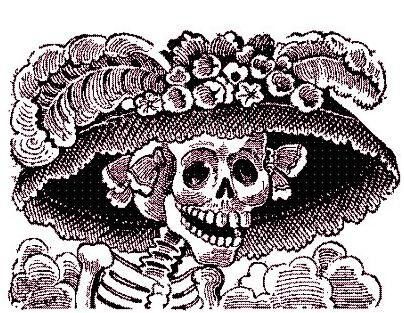
El día de muertos, a la muerte se le disfraza de catrina, y se le escriben versos burlándose de ella llamado Calaveras, donde generalmente se dice que alguien que se quiere ha muerto, o burlado a la muerte de cierta forma. No por decirlo condenas a la persona, es un juego, una fiesta. Hay lugares que, cuando una persona muere, se toca música y se celebra, y el 2 de Noviembre, los panteones se inundan de luz, música y comida, ya que se vuelve una fiesta el que los muertos regresen.
A finales de octubre, se siente la muerte alrededor. Se siente México preparándose y abriéndose. En México la muerte no se teme, ni se olvida, sino que se abraza y se festeja, duele, pero se acepta, y disfruta.
Death exists all over the world, and it has existed since the beginning of times showing the end of cycles. It has been venerated and feared, and even been made fun of. Noone knows what happens after death, and lots of things have been told about it.
Death is very interestingly seen in Mexico. Mexican is not afraid of death, he makes fun of her, wants it, and lives with her day after day.
Here Death is celebrated, a banquet is offered to the death souls of the beloved, we wait for them, and show them the way back home. Halloween is in Mexico as an excuse for disguising, partying, and asking for candies, and as an American influence, but it's not our tradition. We don't have such things as mean monsters that during that day come here to harm us, or legends about death people that return to kill us, like Bloody Mary, or the Candyman. There are legends of ghosts and spirits that are in this earth, crying for us, or paying something they did when alive. People is used to living with death people, they keep talking to them, and feel safe and protected when they feel they are still around. In Mexico, people doesn't die, as memories never die.
On "Día de Muertos", the Death is disguised as Catrina, and several verses are written making fun of her, called "Calaveras", where it is generally said that someone you love is dead, or has made fun of the Death being able to keep alive. You don't condemn the person for doing this, it's a game, a party.
There are places in which, when someone dies, music is played and celebrated and on November 2nd, cemeteries are flooded with light, music and food, and it turns into a party in which dead people come back.
At the end of October, you can feel death surrounding you. It feels Mexico preparing itself and opening. In Mexico, the death is not feared, not forgotten, it is embaraced and celebrated, it hurts, but it is accepted and enjoyed.
El tema de la muerte es sumamente interesante en México. El mexicano no le teme a la muerte, se burla de ella, la ansía, y convive con ella día a día.
Aquí se celebra a la muerte en el Día de Muertos, se pone una ofrenda para recibir a las personas queridas que se murieron, se les espera, y se les muestra el camino de vuelta. El Halloween está en México como una excusa para disfrazarse, ir de fiesta y pedir dulces, y como una influencia Estadounidense, pero no está arraigado en nosotros como tradición. No tenemos cosas como monstruos, o leyendas sobre muertos que regresan a matarnos. Y si las hay, no son las más populares. Las leyendas de fantasmas son espíritus que buscan algo que dejaron aquí, o que perdieron y vagan sin rumbo. La gente está acostumbrada a convivir con familiares muertos, les siguen hablando y se sienten seguros y protegidos cuando sienten que ellos están todavía aquí. En México, la gente no muere, porque el recuerdo no muere.
El día de muertos, a la muerte se le disfraza de catrina, y se le escriben versos burlándose de ella llamado Calaveras, donde generalmente se dice que alguien que se quiere ha muerto, o burlado a la muerte de cierta forma. No por decirlo condenas a la persona, es un juego, una fiesta. Hay lugares que, cuando una persona muere, se toca música y se celebra, y el 2 de Noviembre, los panteones se inundan de luz, música y comida, ya que se vuelve una fiesta el que los muertos regresen.
A finales de octubre, se siente la muerte alrededor. Se siente México preparándose y abriéndose. En México la muerte no se teme, ni se olvida, sino que se abraza y se festeja, duele, pero se acepta, y disfruta.
Death exists all over the world, and it has existed since the beginning of times showing the end of cycles. It has been venerated and feared, and even been made fun of. Noone knows what happens after death, and lots of things have been told about it.
Death is very interestingly seen in Mexico. Mexican is not afraid of death, he makes fun of her, wants it, and lives with her day after day.
Here Death is celebrated, a banquet is offered to the death souls of the beloved, we wait for them, and show them the way back home. Halloween is in Mexico as an excuse for disguising, partying, and asking for candies, and as an American influence, but it's not our tradition. We don't have such things as mean monsters that during that day come here to harm us, or legends about death people that return to kill us, like Bloody Mary, or the Candyman. There are legends of ghosts and spirits that are in this earth, crying for us, or paying something they did when alive. People is used to living with death people, they keep talking to them, and feel safe and protected when they feel they are still around. In Mexico, people doesn't die, as memories never die.
On "Día de Muertos", the Death is disguised as Catrina, and several verses are written making fun of her, called "Calaveras", where it is generally said that someone you love is dead, or has made fun of the Death being able to keep alive. You don't condemn the person for doing this, it's a game, a party.
There are places in which, when someone dies, music is played and celebrated and on November 2nd, cemeteries are flooded with light, music and food, and it turns into a party in which dead people come back.
At the end of October, you can feel death surrounding you. It feels Mexico preparing itself and opening. In Mexico, the death is not feared, not forgotten, it is embaraced and celebrated, it hurts, but it is accepted and enjoyed.
10.29.2010
Iidentidad / Identity
Ayer fui a la inauguración de Darker than Night, exhibición de artistas suecos y mexicanos. Hoy creí estar escribiendo sobre los arte y expresión, pero los trabajos de ayer no causaron tal conmoción en mi como para escribir sobre ellos, sino que me hicieron darme cuenta de algo: identidad. A pesar de que estaban mezclados entre sí, en el momento de ver un trabajo, o de ver otro, era posible saber si era sueco, o mexicano. En ese momento me dí cuenta realmente de lo que es la identidad, de lo importante que es ser no sólo quien eres, sino de venir de donde vienes. El lugar de donde vienes interviene en la forma en la que ves las cosas y así la forma en que produces cosas. No puedo decir que todos los trabajos suecos eran iguales, o que tenían un tema o medio en común, así como tampoco lo puedo decir de los trabajos mexicanos; sin embargo sí puedo decir que tenían algo en común, muy dentro de ellos, que sólo te dabas cuenta al observar la obra.
Suecia y México se encuentran en diferentes períodos históricos y sus habitantes viven en diferentes condiciones, siendo unas cosas más importantes que otras para algunos y viceversa.
Sin ser crítica de arte, me arriesgo a comentar que el arte mexicano está invadido por los deseos de tecnología y el hambre primermundista que no entendemos todavía qué es y la vemos disfrazada en impactos físicos más que intelectuales, diferenciándose del arte sueco en que ellos buscan más el acercamiento a sus raíces con un impacto más conceptual que físico, siendo más valiosa la idea detrás del objeto, video o performance, que el objeto mismo.
La diferencia en la producción de cada objeto también es notable, poniendo de manifiesto los antecedentes nacionales de los artistas, siendo los trabajos suecos más simples y contudentes que los mexicanos, los cuales hemos vivido y aprendido inconscientemente, haciéndonos acreedores sin saberlo, de un imaginario visual mucho mayor en cuestión de color y diversidad.
Yesterday, I went to the Inauguration of Darker than Night, art exhibit of Mexican and Swedish artists. Today I thought I would be ariting about art and expressión, but yesterday's works didn't move me as I thought they would as for writing about the, but they made me realize something: Identity. It didn't matter if they were all mixed, Mexicans and Swedish, but at the moment od watching one piece or another, it was possible to know whether it was Swedish or Mexican. In that moment, I realized what identity was, how important is is not just to be who you are, but to come from where you come. The place from where you come has a lot to do in the way in which you see things and the way in which you produce things.
I can't say that all the Swedish works were the same, or they had the same subject or media, as I can't say taht for Mexican works, either; nevertheless, I can say that they had something in common, deeply inside of them, that you could notice qhen observing the piece.
Sweden and Mexico find themselves in different historical periods and their inhabitants live in different conditions, being some things more important for some than others, and viceversa.
Without being an art critic, I risk myself to say that I found Mexican art invaded by the desire of high tecnology and the first-world-hunger, that we still don't get what is it, and we see ir desguised as strong physical impacts rather than intelectual, diferenciating from Swedish art in the fact that from my perception, they are looking for a more conceptual approach, being more important the idea behind the object, video or performance, than the object itself.
The diference in the production of each object is also noticeable, manifesting this way the artists' background, being the Swedish works simpler and stronger thatn, the Mexicans, which become richer in the manifestation way, as us, Mexicans, have been immerse, learning, without knowing it, a much bigger visual imagery, when talking about color and diversity.
Suecia y México se encuentran en diferentes períodos históricos y sus habitantes viven en diferentes condiciones, siendo unas cosas más importantes que otras para algunos y viceversa.
Sin ser crítica de arte, me arriesgo a comentar que el arte mexicano está invadido por los deseos de tecnología y el hambre primermundista que no entendemos todavía qué es y la vemos disfrazada en impactos físicos más que intelectuales, diferenciándose del arte sueco en que ellos buscan más el acercamiento a sus raíces con un impacto más conceptual que físico, siendo más valiosa la idea detrás del objeto, video o performance, que el objeto mismo.
La diferencia en la producción de cada objeto también es notable, poniendo de manifiesto los antecedentes nacionales de los artistas, siendo los trabajos suecos más simples y contudentes que los mexicanos, los cuales hemos vivido y aprendido inconscientemente, haciéndonos acreedores sin saberlo, de un imaginario visual mucho mayor en cuestión de color y diversidad.
Yesterday, I went to the Inauguration of Darker than Night, art exhibit of Mexican and Swedish artists. Today I thought I would be ariting about art and expressión, but yesterday's works didn't move me as I thought they would as for writing about the, but they made me realize something: Identity. It didn't matter if they were all mixed, Mexicans and Swedish, but at the moment od watching one piece or another, it was possible to know whether it was Swedish or Mexican. In that moment, I realized what identity was, how important is is not just to be who you are, but to come from where you come. The place from where you come has a lot to do in the way in which you see things and the way in which you produce things.
I can't say that all the Swedish works were the same, or they had the same subject or media, as I can't say taht for Mexican works, either; nevertheless, I can say that they had something in common, deeply inside of them, that you could notice qhen observing the piece.
Sweden and Mexico find themselves in different historical periods and their inhabitants live in different conditions, being some things more important for some than others, and viceversa.
Without being an art critic, I risk myself to say that I found Mexican art invaded by the desire of high tecnology and the first-world-hunger, that we still don't get what is it, and we see ir desguised as strong physical impacts rather than intelectual, diferenciating from Swedish art in the fact that from my perception, they are looking for a more conceptual approach, being more important the idea behind the object, video or performance, than the object itself.
The diference in the production of each object is also noticeable, manifesting this way the artists' background, being the Swedish works simpler and stronger thatn, the Mexicans, which become richer in the manifestation way, as us, Mexicans, have been immerse, learning, without knowing it, a much bigger visual imagery, when talking about color and diversity.
10.26.2010
Autumn
En Europa, el paso del tiempo lo anuncian las hojas de los árboles. ¡Qué hermoso es el otoño en Europa! Tan lleno de colores. Las hojas de los árboles te anuncian el paso del tiempo. La lluvia y el frío anuncian el invierno, y poco a poco los árboles se van desnudando y entras a la siguiente estación. El otoño es una estación de transición, pero es tan bello y variable, que nunca deja de sorprenderte.
Al comparar con México, sentí, después de tanto escuchar que el sol no cambia y nunca haber visto las hojas cambiar a amarillo y luego a rojo, que en México, el año lo marcaban las fiestas y las fiestas reflejadas en la mercadotecnia, ya que en cuanto pasaba el grito, los adornos de Halloween empezaban.
No fue hasta este año, regresando, que empecé a sentir el día de muertos, el otoño en México. Lo sentí en el mercado. Olí la fruta, sentí el viento frío como cuando se ponía la mega ofrenda en la UNAM. Sentí el sol diferente. Olí la muerte cerca, visitando, como cada año el 2 de Noviembre. México se está preparando para el día de muertos, no las tiendas, no los mercados, no la televisión, sino México. México, como cada año, se prepara para la gran visita de otoño.
In Europe, the pass of time was announced by the leaves of the trees. How beautiful is autumn un Europe! So full of colors. The leaves int he trees anounce the pass of time. Rain and cold are here warning you about the coming winter, and little by little trees get naked, entering the next season. Atumn is a transitional season, but so beautiful and changeable that it never stops surprising you.
When comparing Mexico, I felt, after so many days listening about the barely change of the sun in the country of the evergreen tress, I thought Mexico was not marked by seasons, but by celebrations, and celebrations reflected on stores, as as soon as one celebration past, the store began selling things for the next celebration, having Christmas stuff as soon as Halloween was over.
It wasn't until this year, back in Mexico, that I began feeling the "Día de Muertos" (Day of the Deaths). I felt it in the market. I smelled the fruits, felt the cold wind, as when I put the "Megaofrenda" in UNAM. I felt the sun different from summer. I smelled the Death near, visiting, as every year on November the 2nd. Mexico is getting ready for the "Día de Muertos", not the stores, not the markets, not the TV, but MExico. Mexico, as each year, is preparing for the great autumn visit.
Subscribe to:
Posts (Atom)