Showing posts with label Light. Lamps. Show all posts

6.15.2011

Annelie Sundin


This is the great designer, who also happens to be cute, funny,
amazing and extremely talented.

I'll begin a new section of my blog talking about young designers with a dear friend of mine, who happens to be Swedish and who kindly host me at her home for some nights. (Thanks, Annelie!).
Her name is Annelie Sundin and I shall declare myself a fan of her work. To my eyes, she is a great product designer, and I do love her products.
A few months ago, she had an exhibition along with two other friends in Stockholm called Metamorphoses. In there she presented some of her bowls and lamps. There is a good thing about her lamps, she is not just a product designer, but a lighting designer, so she creates not just pretty lamps, but she actually knows what she is doing and what she wants to achieve with light.
It's not me the only one recognizing how good she is, as she has just been published in a Swedish magazine called Vårt Nya Hem, in which she describes her work as geometric minimalism.
Her pieces are simple, based on geometry, but with that little of magic that makes them special.
I leave you with some of her products and the link of the website if you want more information.
www.anneliesundin.com

5.03.2011

New Philips led lamp

Hey! Sorry for yesterday's post. I've been a bit sad lately. So sorry. I'll try to make it up to you by talking about a new lamp I found soooo pretty. (no, it's not pink, and not, it doesn't have hearts, stars, o little pretty pink things). It's an A19 retrofixture from Philips.
It is part from the EnduraLED family. It's the EnduraLED A19 (or as their friends call her: EnduraLED 12W 2700K A19 Dimm). It is done with blue LED's and a coat of phosphorus. This acts as a difusser and avoids the multiple shadows, at the same tiem it makes the light warm. This special fixture, can give light all around, making it's ligh resemble that of an incandescent, plus... it just consumes 12 W! Is it amazing, or what?

Right now it costs about 800 mexican pesos, what would be around 70 USD (price here in Mexico), but Philips said that in about 5 years, prices will be reduced to match CFL's! Isn't that great!
There are also other retrofixtures for A19, more for people not to miss completely the form of the old light bulb. They are the EnduraLED 8W 2700K A19 Dimm and the EnduraLED 7W 2700K A19 Dimm
 

4.30.2011

LED's!!!!!!!


Tuesday was such an interesting day! I went to a lecture on led's, by Philips Mexico. I find it amazing. I remember last year, when I had a lecture on led's by Philips Sweden, and the retrofixtures they talked about. This one was really different, beginning with the place, as we didn't go to the Philip's showroom, but to Selca showroom.
I'll write down what I learnt about LED's. (I'm so excited about them... but I still have to study so much...)So... here is a small and very simple explanation on leds.
It seems that leds are a big deal. Philips wants to have 75% of their products made out of leds by 2020.
A LED is a diode made with different kinds of minerals, depending on its color. This diode vibrates and that's how light is produced, that's why it doesn't burn out.
It is important to know that there is not an average lifetime of the led, because it depends on the lifetime of each product. This means that several aspects are taken into account as the drivers, the led, the materials, the design, and how fast it can be cooled down (heat disipator), the diods, and the optics.
There are two ways of making white light: with three diods (RGB) combined or with blue diods and a bubble of phosphorus. The phosphorus can be put in two ways: as a bubble over it working as lens, and something called remote phosphorus. This is a small layer of yellow phosphorus over several blue leds. This layer helps diffuse the light, avoids shadows, and creates a light similar to incandescent and halogen lamps.
There are lamps made with leds called retro-fits. These lamps are made to substitute a lamp previously used, like a PAR, or an incandescent, or an AR111 or so on, giving the same light distribution, temperature, and luxes, but with less energy consumption.

As I have said before, led's are made in a very simple way: minerals mixed that are made into a plaque, that is melted and then cut into small pieces, then each piece is cut and tested in a process called binning, then they are categorized, and sold.
The quality of the leds is very important, as well as the design of the lamp, the design of the heat disipation dispositive, the driver and the optics. If one of these things is not working well, then the lamp wouldn't be as good as expected. This is how some lamps can be differenced.

3.16.2011

Light, life and fast food.

I haven't written for a loooong time, a week or so, I guess, but I have been so busy these days!
Last week, I spent most of the week doing paper lamps for the exhibit on Thursday. I think that the most successful one was one completely made of flowers. It took a lot of time, but was quite pretty. When I have a decent pic I'll post it, promisse. (I didn't take my camera, so I just have iphone pics).
It was a great night. A big party with lots of people watching the different designs. This was done by Adlai Pulido, who is trying to make people know designers and their designs, putting them in attractive environments, such as parties!
The weekend was not so exciting, but on Monday I began working in Sáas, a Lighting Design office here in Mexico, and the project I'm in is... Mc Donald's lighting! It's amazing how it has changed it's image, at least the stablishments all over the world!


So Mexico cannot be left behind and is also changing the McDonalds interior design and its lighting.
While I was making the research, I wondered if it was right going into this project, when I don't like McDonald's at all. In Stockholm I ate one burger that i remember, and here in Mexico, I haven't eaten McDonald's in 10 years!
On Tuesday I went to a McDonald's and could get into everywhere! Employees room, ceiling, kitchen, even the huge refrigerator who reminded me so much of Sweden (because of the deliciously freezing cold)! And well... making a project is so exciting... so I decided I will keep doing the project, even though i will never eat in a McDonald's... ok, i might try something in a McCafé...

I just leave you with the link of the movie called Super-Size me... about McDonald's food...

Hugs and kisses!!!!

3.09.2011

Lamp making

Flowers, flowers, flowers and... oh, yes... flowers. Nothing else I can think about. And no, I'm not becoming a gardener as every living stuff my hands touch somehow dies (still with the trauma that every bean plant I planted just died, or never grew). And yes, I'm still very much into lighting and this is what it is all about.
Some of my lamps are using flowers, so I am making them, just like the ones in the pic. It's been a whole day cutting, folding, cutting, unfolding, cutting, pasting, pinching... and my little hands hurt soooooo much!!!
The good thing about it, is that I had time again for checking out blogs (I've become a blog reader, and follower, and there are some that I love so much sometimes and I post into facebook) and getting more inspiration. Not for designing new lamps as the ones I am making are enought for now, but for continuing working, inspired by works so well done... or by inspired people, or by inspired ideas.
So this was just a post saying... i'm still working! Really inspired... really happy and excited as my thesis is done...
I think life is pretty, weather is warm, the breeze is amazing and things are flowing!
so... let's follow the flow...

hugs and kisses!!!

3.05.2011

Lamp inspiration

There is an event on Thursday called "Diseño para llevar" in a bar called Drakma, in Mexico city, and I was invited as lamp designer. I am so excited about it!
There will be other designers at the event and it's supposed to be like a party-gallery-store-showroom. I haven't gone to an event like this before, and now, I'm in the middle of it!
Last year, exactly a year ago, I was designing lamps, a lamp for being more precise, and I did something called Kaleidoscopical lies, which I eventually loved and pretend to take it to real life as soon as possible. But let's talk about nowadays, when this event is happening and I got to design some lamps. I made some, but i finally didn't like them, so I decided to make some more and I was feeling completly lost looking for some inspiration. I did what a friend told me, that was something like don't think it so much, just do what you feel, and... I ended up doing it.
So, my inspiration changed completely to create my first Collection (hope I can call them that way) of lamps, that will be called: Spring, as it was what inspired me.
Oh, one more thin, I put myself the challenge to use paper as main material and as less glue and other objects as possible!
I don't have the lamps done yet, but I can leave you with my inspiration:


3.02.2011

Winged light

Lately I've been a bit obsessed with luminaries. I just find amazing how many ways of taking light to people might be, and with so many subjects, and each lamp gicing you something extra special in it, so you can say: "OMG! I love it! I absolutely want to buy one!"
Today my inspiration were birds. Not just because I listen to them every morning through my window, or because I love how fragile and strong they can be at the same time (I love fagile stuff) but because I realised they have served as an inspiration for many people with different backgrounds.
First, although they are not lamps, I have to mention Mati Klenell's birds for Iittala(yes, again).


Now, let's begin with the light.

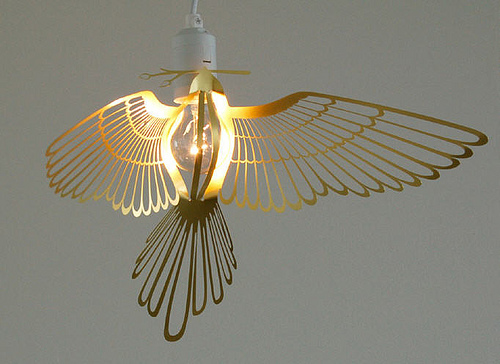
I saw this lamp that looks so pretty. It is from Swedish Hommin, designed by Hung Ming Chen and it's perfect for not leaving a naked light bulb.
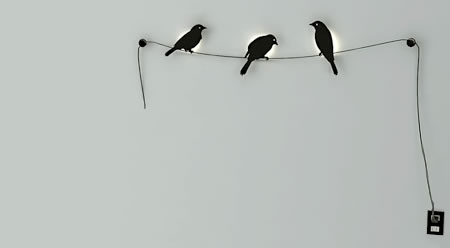
The next one is a Mexican lamp from Eos Studio, called Wirebird. that I found so simple and so pretty at the same time. Check it out.
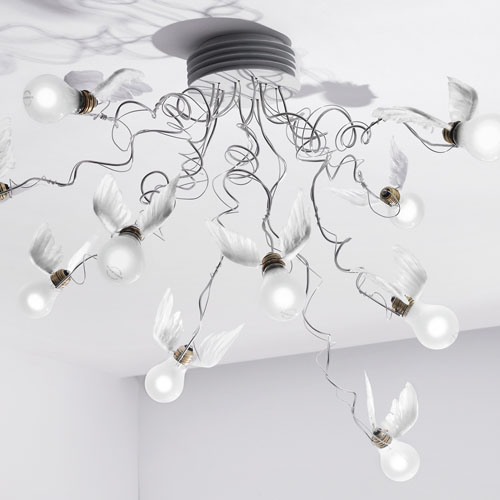
An why not talking about one of the greatest lamp designers (I love his luminaries) called Ingo Maurer, who used the birds as a theme for several lamps such as
Birds, birds, birds
Birdie


and Birdie's nest

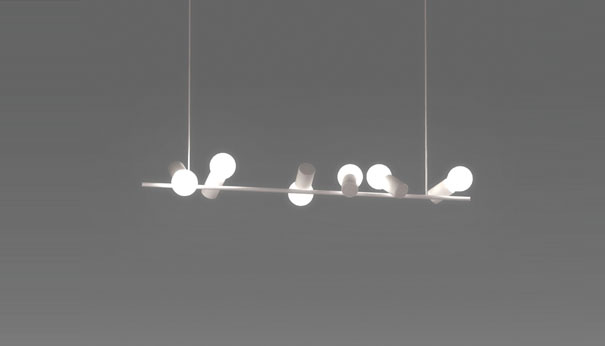
And mixing these two ideas, the simple, yet beautiful lamps by Chinese Zhili Liu, among which we can find:
Sparrow


Nightingale


and Doves


I have found all these lamps so beautiful and simple. I can say these are the most beautiful and inspiring bird lamps I have found on the web. Hope you enjoy these birds as much as I did.


hugs and kisses!!!!

2.18.2011

Hangers and Pegs and Light

I was wondering about lamps made with everyday objects. It seems you can do a lamp with almost anything, or at least that's what many think. Light is not just light and an object is not just an object, and a lamp... well a lamp can be much more than a lamp.


Anyways, I was thinking in the Clothes hanger lamp, sold by Droog and designed by Hector Serrano and decided to search lamps done with these kind of elements for hanging cloths. I found a pendant done with hangers called Light MI and designed by Miriam Zink, which I find extremely beautiful, and two amazing creations done with pegs: the Peglight by David Olschewski and the Lighting Pin by Sungho Lee.


I let you with these four that I found lovely and interesting, even challenging. Enjoy!


Clothes hanger lamp by Hector Serrano


Light MI by Miriam Zink


Peglight by David Olschewski


Lighting Pin by Sungho Lee

1.12.2011

History of Chandeliers

Chandeliers are classic lamps that have been around us for long, long time, so I thought it would be interesting to know a bit about its history as the ethimological meaning and the definition from Wikipedia I gave in the previous post were not enough, at least for describing many chandeliers.

The first “chandelier” or thing resembling to one was called “the polycandelon”. According to designboom, it used several glass bowls/cones in a bronze/iron frame.

The earliest chandelier, around the 15th century, were a cross-shaped “frame” made with two beams of wood with a candle at the end of each. These candles, unlikely the ones we use nowadays made of wax, were made of animal fat. They were hung to the desired height with a rope or chain suspended from a hook. At the beginning, these were used to light up big places of reunion, like medieval churches, abbeys and monasteries.

Afterwards, chandeliers evolved and their designs began to chance, becoming part of wealthy homes as a status symbol. They were usually hung in the middle of the houses of wealthy merchants, palaces and mansions. Lighting after daytime was really expensive, so just the wealthy families could afford having a lighting fixture, specially a fancy one. With a form based on rings or crowns, it was a kind of “jewelry for home”.

It is also believed that more modest household could have more modest chandeliers if they had access to raw materials for candle making, and some wood, metal, iron, or tin.

Well, design, as life, continued evolving, and suddenly, around the end of the 16th century, other materials began to be added, like mirrors, shining brass plates, and light breaking rock crystals or quarts, which by the way were not easy to cut. This were used in the candle holders, hanging from the base of the chandeliers, so light could pass through them to the room, changing it a bit, with an amazing effect.

These rocks were rare, hard to cut, and very expensive, not to mention, irregular in shape. So pressed glass began to be used, but it was not so good because of its refraction qualities. It was also hard to cut and could not acquired the shapes the rock crystal had.

Designers wouldn’t stop until they could find a material or a way to design with this beautiful effect, so they kept trying and trying until 1676. In this year, an English glassmaker named Geroge Ravenscroft, developed a new kind of glass that was a bit like the rock crystal. He added lead oxide to the glass while making it, and suddenly (well, after several experiments in fact), the material became softer and very refractive, even more than rock crystal. It’s fun if you consider this was known in Mesopotamia in ancient times, but just discovered by the “modern world”.

According to Jutta-Arnette Page, curator of the European Collection at the Corning Museum of Glass at New York, its highest moment was this. Ravenscroft gave a sparkle to crystal with this invention and a real crucial moment to chandelier design.

Changes didn’t stop in there. Around the 1700, beautiful mouth-blown glass chandeliers were made on the Venetian island of Murano. They had been making fine glassware since the 13th century, but it was not until the 18th they began making chandeliers. Nowadays they keep on making them and exporting them.

In 1724, in what was Bohemia then and now the Czech Republic, a glasscutter named Josef Palme had royal permission for making chandeliers in Prachen, at the north, starting the Bohemian chandeliers that can be found all around the world.

But there are some crystals that a really like, as jewelry specially, and that can also be found on chandeliers: Swarovsky crystals. In 1895 Daniel Swarovsky and his brother-in.law Franz Weis set up a factory near Innsbruck, Austria. In this small workshop, Swarovsky patented a machine for cutting extremely well jewelry stones, and afterwards, he thought, oh, well… why not trying this for cutting crystal? So he began cutting crystal chandelier pieces, and with this, the purity of leaded glass crystal was flawlessly brilliant.

Not just materials changed, but design. Give a child new pieces for the game, and new toys, and stories will be created. So yes, design changed along with the new materials, and fashion of the time. It’s amazing that no other lamp has shown so many different designs and exaggerations.

Luckily, not only the extremely wealthy could buy chandeliers. They became accessible for middle class, in other materials and designs. The designs continued evolving with fashion, giving us chandeliers of so many different styles such as art nouveau, art deco, and others, like Rococo, which in the 1750’s influenced the design a lot with crystals for a bit of sparkle. In 1765 Robert Adam made them longer, and the arms of the chandeliers instead of having some crystals were adorned with chains of them, as the production of lead crystal became cheaper at the time,and the candle sockets changed and depending on the time, some bells and flowers were added.

As we can see, the 1700’s was the century where more details were added to chandeliers. The arms were curved in lots of directions. In 1879, Louis Comfort Tiffany made the first stained glass chandelier.

After WWII, design was great, always looking for new forms, so the chandelier was back to life. The names now were not just of manufacturers and those managing crystals, but of designers such as Gino Sarfatti, Achille Castiglione and Ingo Maurer.

As times changed, and new inventions were brought, candles were substituted by gas, and then electricity. In the 19th century, gas was the main source of illumination, and as chandeliers wouldn’t be left behind, so the gasolier was invented: gas+chandelier. But at the end of this century, when the chandeliers were changed to gas, electricity was introduced, and electric chandeliers became the usual. Many people criticized this and designers began creating new models for the new lamps.

As we can see, chandeliers are not a normal lighting fixture. They have been with us since long ago, and will still be with us for much more, evolving with time and bringing us magic and dreams every time we turn them on.

Internet sources:

http://www.worldartglass.com/index.asp?mc=art9

http://www.pressreleasepoint.com/brief-history-chandeliers

http://www.abbeychandeliers.co.uk/crystal_chandeliers_history.html

http://ezinearticles.com/?A-History-of-Chandelier-Pendant-Lighting&id=4034303

http://www.designboom.com/history/p_chandelier.html


1.02.2011

Chandeliers


I'm into an interior design project right now, and the user wants a chandelier. Entering to a chandelier stores I discovered some that are ridiculously expensive, so, as a lighting designer, with a mother that knows a bit about crystals and jewlery and as a nice girl who believes in making people happy, I've decided to design one.

But, before beginning with the design, I most know what is a chandelier.
According to wikipedia, a chandelier is "a branched decorative celing mounted light fixture with two or more arms bearing light." As something more, I should say she doesn't want a simple chandelier, just with lots of arms and light sources, but one with lots of cristals, as the sparkle is what makes her love this kind of lamps.

So, may this be an introductory speech on lamps sections, and more specifically: Chandeliers.

Oh, just some more interesting dara from Wikipedia: "The word chandelier appeared ub the English language in the late 14th century, directly frim the 12th century old french word Chandelier, this was a new spelling of the earlier 10th century French word chandelabre which in turn comes from latin Candelbrum from the latin Candela meaning candle."